
Cyber, connectivity and AI adoption: what six months in the industrial sector has taught us

Posted:

10 / 13 / 2025

Tagged:

Industrial - Person using interface

Six months on from WiredScore’s launch into the industrial sector, the market context is continuing to shift. Investment volumes are climbing, occupier demand is resilient, and landlords are having to think differently about how their assets perform.

Knight Frank’s latest research shows £1.4 billion of transactions in Q3, marking the third straight quarter of year-on-year improvement. Take-up for larger units hit 10 million sq ft in Q2, the highest since 2022, pushing H1 totals to just over 18 million sq ft. At the same time, vacancy has crept up to 7.7%, the highest level in 11 years, and average industrial rents have risen 4.8% year-on-year, with forecasters revising growth expectations for 2025 upwards.

In other words, activity is strong, but competition is intensifying. As more space comes onto the market, digital performance, resilience and future-readiness are increasingly what set buildings apart. Through our certification work and conversations with clients, six clear lessons have emerged that show where the sector is moving, and where the gaps still lie.
1. Cybersecurity is climbing the agenda

Until recently, cybersecurity was rarely a core consideration in industrial real estate. High-profile incidents, such as the attack on Jaguar Land Rover, have changed that.

Developers are now recognising that physical infrastructure is a key line of defence in cybersecurity. Questions around network redundancy, telecom room security and cabling containment are becoming more common.

This shift is significant. Landlords who address cybersecurity through robust digital infrastructure are positioning themselves as reliable partners, supporting occupiers to manage operational risk in a more complex environment.

2. Yard automation is reshaping space requirements

Yard spaces are emerging as a critical part of efficiency gains. As automation and autonomous vehicle technologies mature, they are transforming how space is used outside the warehouse itself.

In the UK, where large yard areas are typical, automation offers the potential to reduce footprint while increasing throughput. Automated systems can optimise parking, routing and scheduling with greater precision than manual operations.

Forward-thinking developers are already exploring how to digitally enable yard spaces, recognising the opportunity to future-proof assets in response to operational trends.

3. The infrastructure baseline still needs improvement

Despite strong capital growth – 5.21% annually as of August – too many industrial assets are let down by basic infrastructure shortcomings.
WiredScore assessments have uncovered a pattern of avoidable issues, such as:

  • Fibre cables emerging unprotected from warehouse floors
  • Fibre loosely attached to pillars with no containment
  • Security teams holding multiple keys for telecom cabinets without clear access procedures

These gaps reveal a wider maturity issue. While headline market performance remains strong, underlying technical resilience often lags. Addressing these fundamentals isn’t glamorous, but in a market where vacancy is rising, poor infrastructure can quickly become a leasing liability.

4. Tenants are willing to co-invest in connectivity

Occupiers are becoming more selective. With rents rising at 4.8% annually and growth forecasts revised upwards, many are looking to extract greater value from the buildings they occupy. One emerging trend is their willingness to co-invest in digital infrastructure improvements.

We’ve seen multiple cases where tenants have offered to contribute to upgrade costs once they learned their landlord was pursuing WiredScore certification. This reflects how central connectivity has become to operations—from warehouse management systems to data-heavy automation.

For landlords, this presents an opportunity to partner with occupiers to deliver long-term value, rather than bearing the full burden of upgrades alone.

5. AI adoption is limited, but readiness is rising

AI is often portrayed as transformational for logistics, but current adoption in warehouses remains relatively low. What has changed is how developers and landlords are preparing for future demand.

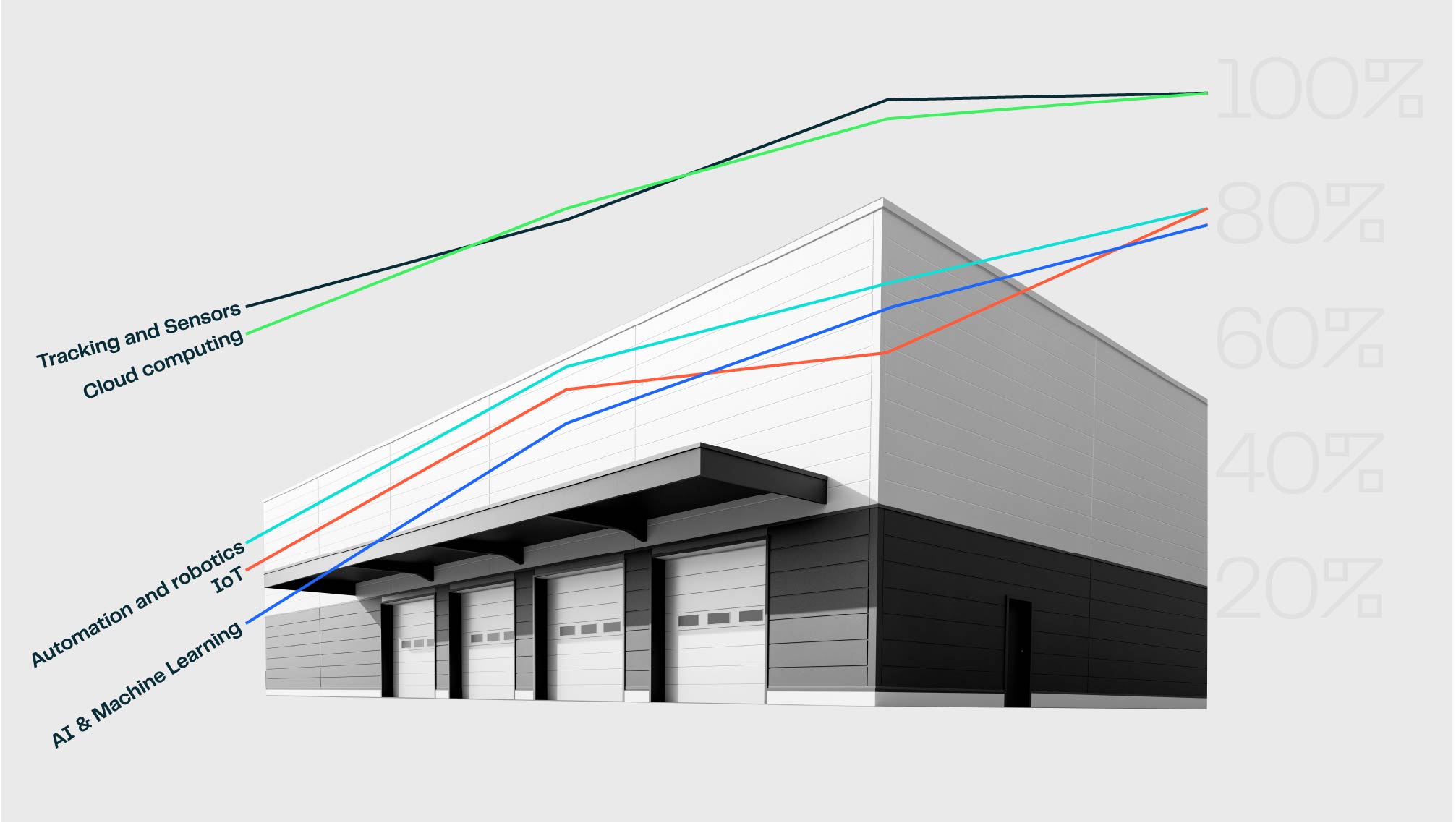
The focus is increasingly on AI readiness: ensuring networks, power capacity and data infrastructure can scale to support future technologies. This is reflected in WiredScore’s research, which shows occupiers planning for AI, IoT and automation adoption over the next five years.


Source: WiredScore research, 2025.

6. Benchmarking shows a sector in transition

WiredScore’s certification data is beginning to reveal how industrial real estate is shifting. Comparing existing buildings with new developments shows a sector moving decisively towards more advanced digital and sustainable infrastructure.

Key trends include:

  • Telecom resilience is being built in by default. Fewer than one in five existing buildings have diverse telecom intakes, yet every new development now plans for them.
  • Connectivity choice is expanding. Fewer than one in three existing sites have multiple network providers, but over three-quarters of new projects aim to offer them.
  • Renewable energy adoption is increasing. Nearly four in five new developments target PV (solar) panels as part of sustainability strategies.
  • Power capacity remains a weak spot. WiredScore’s benchmarks are not currently being met by any projects. There is a clear gap between occupier needs, marketing promises and what developers can control.

With vacancy rates at an 11-year high, the ability to demonstrate technical resilience and future readiness is no longer optional. Benchmarking is giving landlords the data to see clearly where they stand and to prioritise investment in the areas that will have the biggest impact.

Key takeaways

  • Cybersecurity is becoming a core consideration for landlords and developers.
  • Automation is changing how space is used, particularly in yard areas.
  • Many sites still need to address fundamental infrastructure gaps.

  • Occupiers are increasingly open to co-investment in digital upgrades.
  • AI readiness is rising, even if current usage remains modest.
  • Benchmarking is exposing clear differences between existing and new assets.

Since launch, WiredScore Industrial has seen rapid adoption from leading landlords, developers, and investors.
We’re now working with 35 clients across the Netherlands, Germany, France, the United States, Spain, the United Kingdom, and Ireland — covering over 18.5 million sq ft of industrial and logistics space.

Digital infrastructure for the next era of industrial assets.

WiredScore certification for Industrial
Press enter or esc to cancel